There is Hope for Ukraine, and Our Support is More Important Than Ever
By: Sarah Sokhey, University of Boulder Professor and Award-Winning Author
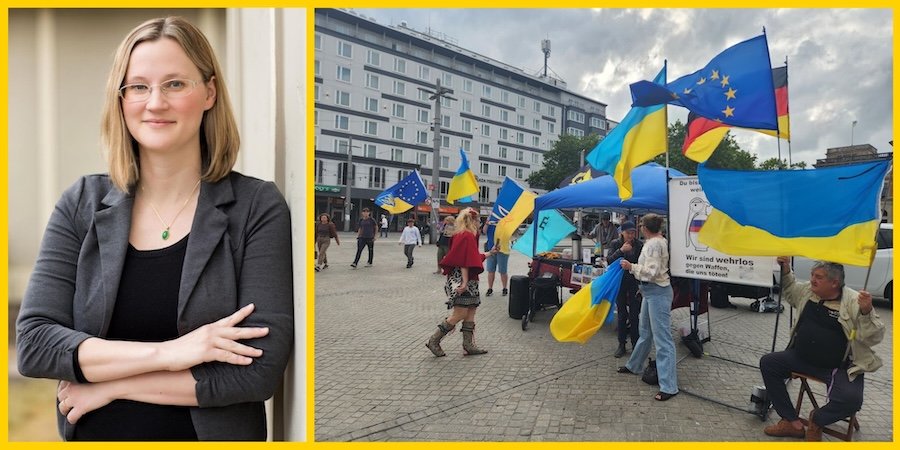
Photo: A local pro-Ukrainian group at the train station in Bremen, Germany
The war in Ukraine—caused by an unjust and unprovoked attack by Russia—is now in its 5th year, having become a protracted crisis with no clear or immediate end in sight. The costs of war have mounted, with war crimes committed by Russia still being commonplace as civilians are increasingly targeted in the summer of 2026.
At this moment of deep uncertainty and prolonged war, how are Ukrainians faring? What do they think about the conflict? And are there reasons for hope?
In June 2026, John O’Loughlin, Gerard Toal, and I ran a nationally representative survey of Ukrainians conducted by the Kyiv International Institute of Sociology (KIIS). Survey work is still very commonplace and possible in wartime Ukraine, although there are major challenges. In-person interviews are not viable, and we cannot interview people in occupied territories. The survey is conducted by randomly generating mobile phone numbers—a method called Computer-Assisted Telephone Interviewing or CATI—but response rates are only 7 percent, meaning KIIS must call a lot of numbers to get a nationally representative sample with 1,801 respondents. Accurate statistical analysis of the responses requires us to account for demographic characteristics, but no official census has been conducted since 2001. KIIS provides official demographic data from 2025 instead as the next best approach.
Our questions asked Ukrainians about their preferences for a peace agreement, drafting younger soldiers, their fatigue, and their trust in leaders in Ukraine, the EU, and the US. We have seen remarkable resilience from Ukrainians, but there are very real limits to human endurance. Respondents might feel social pressure to respond that they are not tired of the war as a sign of patriotism and loyalty, so we modify our approach and ask whether individuals are worried about their fellow Ukrainians feeling war fatigue. An overwhelming 70 percent of Ukrainians are worried “a lot” about war fatigue among their fellow compatriots. Only 5 percent report being “not at all” worried about war fatigue.
War fatigue makes outside help all the more critical; there are very real human limits to the unreasonable amount of resilience Ukrainians have been forced to have. We have seen a growth of non-profit organizations around the world—like Sunflower Seeds Ukraine—which provide local-to-local connections and support. These kinds of efforts can be invaluable. This also likely explains why Ukrainians still see Americans as friends even though they often see the U.S. President as an enemy and have little confidence in his team tasked with negotiating peace in Ukraine.
From the same survey referenced above, we find that 36 percent of Ukrainians see Trump as an enemy and only 17 percent see him as a friend. A remaining 23 percent and 22 percent see Trump either as a bit of both friend and enemy or answered, “don’t know”. We further find that 57 percent of Ukrainians have no confidence in the US team of Jared Kushner and Steve Witkoff. Given the Trump administration's withdrawal of a large portion of US military aid and the closing of USAID—which had a significant presence in Ukraine—it is not shocking that Ukrainians do not see the US administration as their unambiguous friend. Additionally, a quarter of Ukrainians feel negative about the role of the US in world affairs, and 62 percent have mixed feelings, with only a very small number of respondents (7 percent) feeling positive about the US role in world affairs.
When asked about Americans in general, however, Ukrainians are much more positive. An overwhelming majority of 73 percent see Americans as friends of Ukraine, and a mere 4 percent see them as enemies. The enduring positive assessment of Americans is in no small part due to the efforts of organizations like Sunflower Seeds Ukraine. Many American citizens are seen as—and in reality still are—supportive of Ukraine, and the non-profits created in the aftermath of the full-scale invasion have changed the landscape of non-profit work in the United States, even drawing in people with no personal connection to Ukraine and no previous work related to Ukraine.
My own research on local politics in Ukraine shows the importance of local actors for keeping daily life going and in rebuilding the country during and after war.
To understand the importance of the local level in Ukraine, we have to go back, at a minimum, to the Euromaidan Revolution of Dignity. In fall 2013, the then-President Viktor Yanukovych was negotiating a possible economic deal with the European Union or with Russia. After seeming to play both sides but on the cusp of signing a trade agreement deal with the European Union (critically, not EU membership, but a trade deal), Yanukovych pulled out of the EU deal at the last moment. This prompted significant protests led initially by students. Yanukovych decided that repression—shootings, beatings, and imprisonment—was the best response. Ukrainians disagreed. The result was sustained mass protests that became a months-long violent ordeal unlike the peaceful Orange Revolution in 2004 against electoral fraud. The Euromaidan Revolution of Dignity in late 2013 through early 2014 culminated in Yanukovych fleeing Ukraine for Russia and kickstarted an important political and cultural shift.
What does Euromaidan have to do with local politics and the war in Ukraine today?
Many still overlook that the war really began in 2014 when Russia invaded the eastern territory of Donbas and illegally annexed Crimea. It was at this same time that Ukraine pursued a massive reorganization of the local level of government in the country and simultaneously began decentralizing power, giving local governments in Ukraine the legal ability to retain their own tax revenue, set their own budgets, and make many more of their own policy decisions. This was truly exceptional timing. Most countries centralize power during war, trying to mobilize national resources. Ukraine chose to decentralize power during war and did so, explicitly, as part of the effort to reduce corruption and improve the provision of public services and the quality of life throughout the country.
When the full-scale invasion happened in 2022, decentralization had been fully completed and the newly formed hromadas (the local territorial communities) had leaders who had been elected in free and fair and competitive local elections in fall 2020. Even though those local elections were held at the height of the pandemic and not alongside national elections, the average turnout was around 40%, with some locales even having up to 80 percent turnout. Furthermore, my co-authored research shows that locales with higher turnout in the 2020 local elections showed higher levels of spending on social protection in 2022, suggesting that democratic engagement may have influenced budgetary priorities. In short, the local level was already being successfully strengthened before the full-scale invasion in February 2022.
The strength of Ukraine’s local communities is credited with its resilience—unexpected by some outside observers—when Russia attempted to take over Kyiv. Not only were volunteer and spontaneously organized territorial defense units already in existence since 2014, but local communities worked among themselves and with each other to adapt to an influx of internally displaced persons and outpouring of people leaving the country for what was hoped would be a short-term conflict. Decentralization directly contributed to Ukraine’s resilience.
My research builds on that of Ukrainian scholars like Oleksandra Keudel and Oksana Huss and others who explain how and why Ukrainian communities are so resilient. In the June 2026 installment of the “Community Monitoring Report” published by Vox Ukraine, Yuliia Markuts, Andrii Darkovich, and Vlaydslav Shymanskyi note that local revenue is steadily increasing and detail the pending legislation which may expand the official role of local governments in national security and attracting international investors.
Ukraine’s very local level efforts drive the country’s national resilience. Oded Adomi Leshem might classify this as a very practical and sustainable kind of “optimal hope”. This is a hope in which two important things are separate: desires of what one would like the world to be, and expectations about what is possible and when. In a speaker series I have helped organize since fall 2023, some Ukrainians express a clear vision of what victory for Ukraine would be and what they are working for at the same time that they are uncertain about when, how, or even whether those goals are possible in the short term. Nonetheless, they persist. Optimal hope means taking whatever action you can—small or large, local or international—in pursuit of the world as you would like it to exist even, and especially, when you do not know what is possible. One of our guest speakers, Tata Kepler, a renowned activist, businessperson, and NGO founder and recipient of a Legend of Ukraine award, put this best: “Just do something….and never stop.”
To us, the supporters of Sunflower Seeds Ukraine, Ukraine’s local resilience shows why our small daily efforts, the showing up and trying where we can, adds up to something much greater. Or as U2, Taras Topolia, and Ed Sheeran say in their song to Ukraine, Yours Eternally: “If you have the chance to hope, it’s a duty.” We hope and work every day because we must. For Ukraine, and for ourselves, and for freedom and democracy in the world.
*****
Suggested reading for more in-depth updates from Ukrainian sources: