Ukraine Support Act Passes in US House - Fate Uncertain in Senate
On Thursday, June 4th, the House voted 226 to 195 to pass the Ukraine Support Act (H.R. 2913). The measure includes strict sanctions on russia’s banks, oil, and mining companies, 500% tariffs on russian goods imported to the US, and a ban on russian crude oil imports. Also included is new military support for Ukraine in the form of $8 billion in weapons sales, an extension of the Biden-era military lend-lease program, and $1.3 billion in security assistance.
The bill still needs to pass the Senate, where its fate is uncertain. We urge our supporters to follow the developments of the Ukraine Support Act, and to call, email, and write to your senators to voice your support for the aid package.
As russia ramps up its attacks on civilian targets, it is critical that we supply Ukraine with everything we can to protect itself from russian aggression.
putin Rejects Zelensky’s Offer of Peace Talks
Recently, President Volodymyr Zelensky published an open letter to putin proposing an in-person meeting to discuss ending the war. To no one’s surprise, putin immediately rejected the opportunity to do so.
Zelensky’s letter, which marked the first direct outreach from Zelensky to putin since the start of the full-scale invasion in 2022, was meant for more than just putin’s eyes. It was also aimed at putin’s inner leadership circle, which some sources have claimed is growing increasingly weary of the war. Zelensky’s proposal of peace talks and putin’s subsequent refusal makes it explicitly clear to who is genuinely seeking a path to peace and who is standing in the way.
Ukraine Strikes Military Targets 1,000 Kilometers Deep Into russian Territory
In early June, Ukrainian drones struck military targets deep into russia in the area around St. Petersburg. Targets included an oil depot, a military port, and an ammunition depot. The strikes took place amidst russia’s annual St. Petersburg International Economic Forum, where multiple russian dignitaries were in attendance to witness the attacks.
The operation represents more than just a tactical victory. It demonstrates Ukraine’s increasing abilities to strike targets deep (~1,000 kilometers) within russia’s borders using its own domestically produced drones. For the first time, many russian civilians are seeing first-hand the effects of the war their own country started.
Ukraine’s “Middle Strike” Campaign Threatens Russian Logistics
Ukraine has significantly ramped up its intermediate-range “middle strike” campaign, systematically targeting russian military infrastructure situated 100 to 200 kilometers behind the front lines. Ukrainian forces have launched coordinated operations hitting vital logistics depots, ammunition warehouses, and railway junctions at key transit hubs in occupied Donetsk. President Volodymyr Zelensky highlighted that Ukrainian forces now possess the capability to disrupt the Kremlin's supply networks across virtually the entire depth of occupied territory, effectively eroding Moscow's capacity to sustain its frontline offensives.
The ripple effects of these deep operational strikes are causing mounting structural headaches for the russian military. Analysts note that by targeting the fuel pipelines, transport lines, and command hubs that feed the front, Ukraine is successfully inducing localized fuel and ammunition shortages, most notably choking off major ground lines of communication leading into occupied Crimea and eastern Ukraine. By keeping pressure on these vital arteries, Ukraine is forcing russian commanders to decentralize their storage and lengthen their supply lines, severely blunting the momentum of russian ground operations.
More Strikes Against Ukrainian Civilians
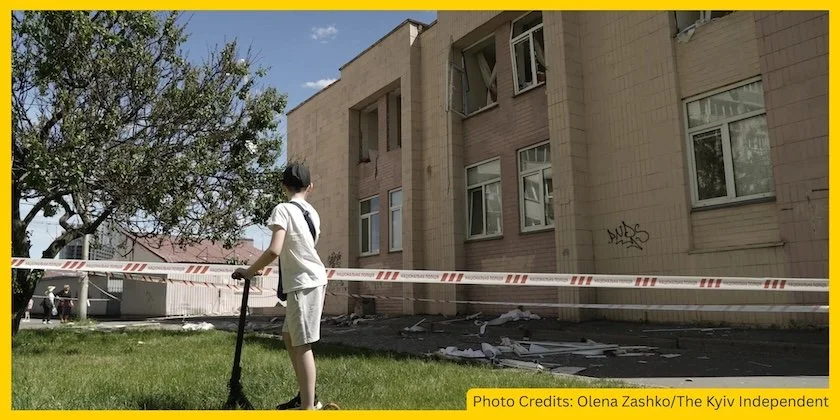
On June 2, russia conducted yet another massive aerial strike on Ukrainian cities, including the capital of Kyiv. At least 23 civilians were killed, including two children, with over a hundred others injured. Included in the casualties was a Ukrainian State Emergency Service rescuer who, during his efforts to rescue civilians from the rubble of an initial attack, was killed by a secondary “double-tap” strike meant to target emergency personnel. Such attacks are considered war crimes by virtually every civilized society in the world, but for russia constitutes standard operating procedure.
In at least one attack in Dnipro, it was reported that russia used cluster munitions, which scatter many small explosives over a large area. These explosives often fail to explode immediately, which pose an increased risk to civilians who may encounter them later (think: a child playing in a field). These ordnances are widely banned under international humanitarian law.
The attacks highlight Ukraine’s need for additional defenses, especially ballistic interceptors, to protect itself from russia’s callous aggression.
To our friends, family, and Sunflower Seeds Ukraine team members living in Kyiv and other Ukrainian cities, we hope you remain safe.
Sources:
CNN.com, June 4, 2026
Congress.gov, 2026
KyivIndependent.com, June 5, 2026
KyivIndependent.com, June 6, 2026
KyivIndependent.com, June 2, 2026