russian Explosive Devices Found in German Airport
On August 4th, a drone carrying an explosive device was discovered at Leipzig/Halle Airport in eastern Germany, not far from Ukrainian cargo planes. Fortunately, the detonator proved faulty, and the drone failed to explode. A second drone did make contact with another cargo plane, causing minimal damage, and a third drone laden with explosives was discovered near the airport 10 days later.
Now, a month later, German officials are blaming russia for the attack and have vowed to shut down a russian consulate in Bonn as well as the Russian House in Berlin, which is a suspected russian espionage hub. In addition, Germany will be implementing tighter entry controls for russian nationals and increasing pressure on the russian shadow fleet.
moscow has denied the allegations and accused Germany of planting the explosives themselves.
The plot represents a continuation of russia’s attempts to test the resolve and defenses of neighboring countries that have reported an increase in hostile russian activity. Last September, Poland shot down 19 russian drones that had invaded their airspace, and just a few months ago a russian cruise missile crashed in Polish territory.
After Wildberries, Ukraine Targets Ozon
Now that most of Wildberries’ largest and easiest-to-hit facilities have been destroyed, Ukraine has set its sights on Wildberries’ competitor, Ozon. Ozon has also been providing logistical support to russia’s military, and is now reaping the consequences. The first warehouse was destroyed in Samara Oblast on August 22. Several days later, four more warehouses were hit. Like the Wildberries attacks, the destruction of the e-commerce warehouses is intended not only to disrupt russian military logistics, but also to bring the war home to russian civilians through major financial shocks.
12 Million Books Destroyed in russia's Cultural Assault
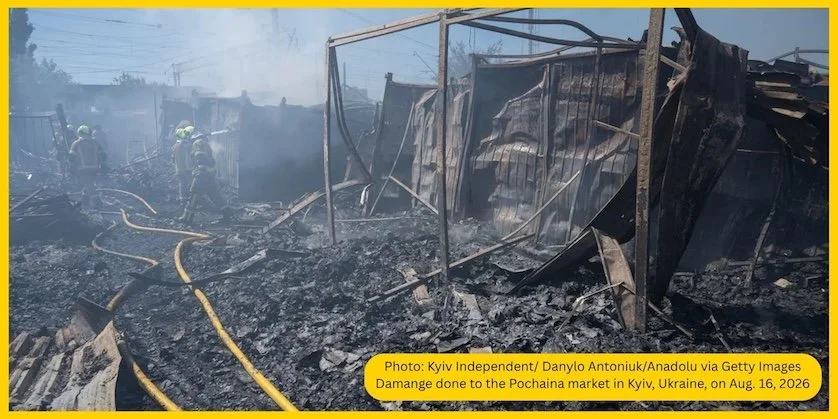
Ukrainian cultural and historical centers have been targets of russian attacks since the beginning of the invasion. In recent weeks, 35 book publishing facilities have been hit, and 12 million books have been destroyed. One facility, now in ruins, was ramping up production for 1.3 million of Ukraine’s school textbooks, representing 10% of their annual textbook supply. Other targets include the Pochaina Book Market, which once housed hundreds of book vendors with books from over a hundred different publishers, as well as a warehouse owned by Ukrainian publishing house Ranok.
These attacks are part of a broader effort by russia to suppress Ukrainian culture and identity. While some institutions are making efforts, such as digitizing art and literature and moving religious artifacts to safer locations, immeasurable damage has already been done. Museums, art galleries, opera houses, and even Ukraine’s famous Dormition Cathedral have been hit.
—
From drone attacks on European soil to the burning of Ukrainian books, russia continues to expand the reach and ruthlessness of its aggression. But Ukraine continues to answer on the battlefield and in the preservation of its irreplaceable cultural heritage.
Sources:
BBC.com, September 1, 2026
NPR.org, September 2, 2026
AtlanticCouncil.org, September 1, 2026
KyivIndependent.com, August 27, 2026
KyivPost.com, August 27, 2026
KyivIndependent.com, August 16, 2026
BBC.com, August 31, 2026
Detector Media, September 1, 2026